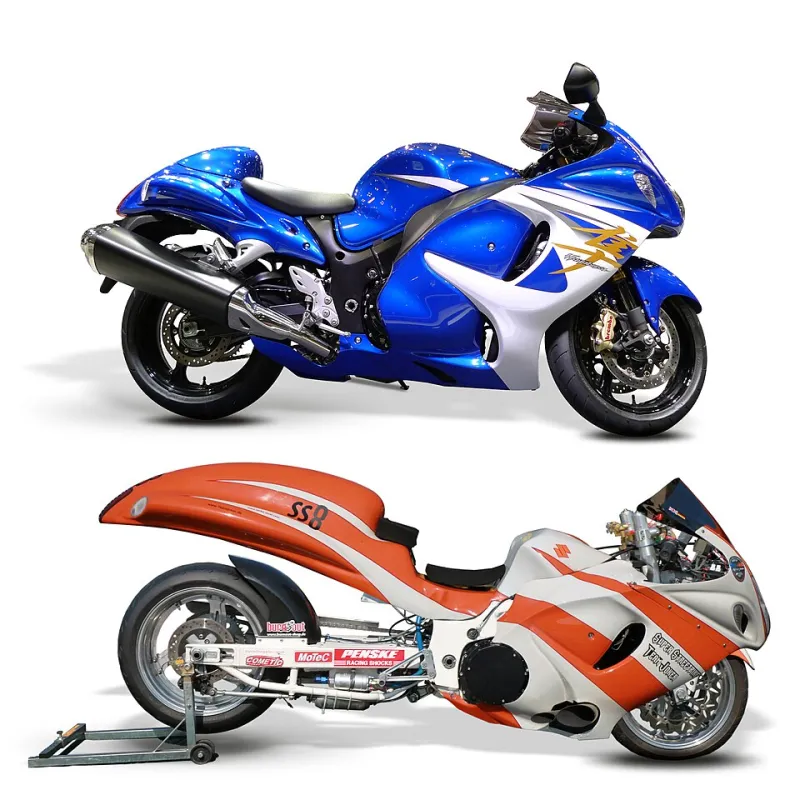
One Family, One Parts Bin: Tracing the Hayabusa's Secret Kinship With Suzuki's Smaller Hawks
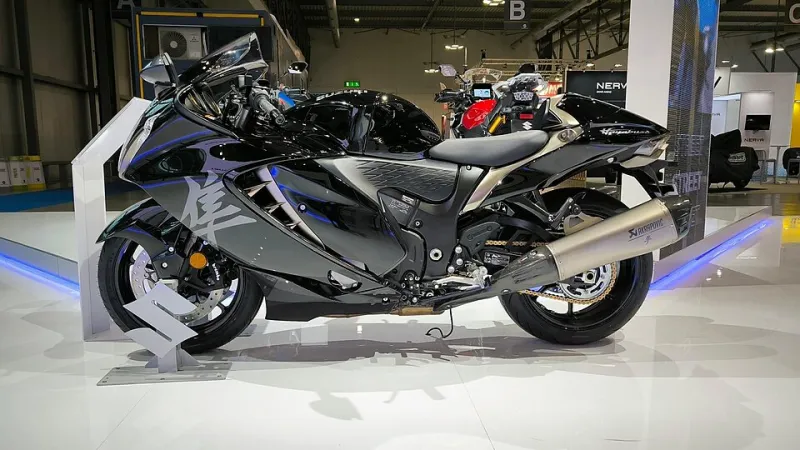
Photo: AVMOTO, CC BY-SA 4.0, via Wikimedia Commons
Stand next to a Hayabusa at any dealer event in America and you'll hear the same comment over and over: that thing is a monster. Fair enough. It's a 1,340cc hypersport with a reputation built on Texas mile runs and quarter-mile bravado. But here's what most folks miss when they're gawking at the big bird — under all that mass, the Busa shares more DNA with Suzuki's smallest sportbikes than almost any flagship shares with its little siblings.
The Family Tree Nobody Talks About
Suzuki doesn't really do bespoke. Never has. Walk the GSX lineup at a dealership — say, a store in Ohio or Southern California with a full floor of GSX-Rs, a GSX-S, and a Hayabusa on the end cap — and you're looking at variations on a theme. The same engineering philosophy shows up everywhere: shared platforms, shared electronics architecture, shared supplier relationships.
That's not laziness. That's how you keep a flagship priced like a bargain. The Hayabusa's value proposition in the US market has always hinged on delivering hypersport capability without the exotic price tag, and the parts-bin strategy is the reason why.
Where the Electronics Grew Up Together
Start with the brain. The current-generation Hayabusa's electronics suite — the IMU-driven cornering ABS, traction control, launch control, and ride modes — didn't materialize out of thin air for the big bike. That architecture was developed and refined across the GSX family, trickling up and sideways through the GSX-R line before landing in its most polished form on the Busa.
Ride a modern GSX-R750 back to back with a Hayabusa and the interfaces feel like cousins. Same menu logic, same button placement philosophy, same tuning philosophy. If you're cross-shopping bikes in a showroom, that consistency matters more than spec sheets admit. Learn one and you've mostly learned them all.
Brakes, Brembos, and Borrowed Bones
The braking hardware tells a similar story. The Busa's Brembo Stylema calipers and massive rotors are the flagship expression of components that exist across Suzuki's sportbike stable in various trims. Radial master cylinders, stainless lines, the whole stoppy setup — the lineage is obvious once you know what to look for.
This is also where buyers get tripped up. People compare the Hayabusa against European flagships and assume the hardware is a generation behind because the price is lower. It isn't. It's the same supplier parts at a friendlier number, because Suzuki amortized development across the whole lineup instead of hanging it all on one bike.
What This Means When You're Shopping
Here's the practical takeaway for anyone standing on a showroom floor this season:
- Resale and service parts are plentiful. Shared components across the GSX family mean pads, levers, sensors, and electronics modules are rarely backordered the way they can be on low-volume exotics.
- The aftermarket follows the family. Tuners who know the GSX-R electronics know the Busa's. Your local dyno guy probably already speaks the language.
- Cross-shopping is fair game. If you love the Busa's feel but want something smaller, the GSX-S and GSX-R lines offer a genuinely related experience, not a marketing approximation of one.
The Hawk's Quiet Advantage
There's a reason the Hayabusa keeps winning comparison tests against bikes costing thousands more. It isn't just the engine, though the engine is legendary. It's that the Busa benefits from every lesson Suzuki learned building its entire sportbike range. The big bird is the sum of the whole flock.
So the next time you're at a dealer event and someone calls the Hayabusa a dinosaur, smile and nod. Then point out that its electronics, its brakes, and its core engineering philosophy live on in every modern GSX on the floor. The ghost of the Gixxer diet didn't starve the Busa — it fed it. And for buyers in the US market hunting for hypersport performance at a sensible price, that shared bloodline might be the smartest argument for signing the paperwork.