From the Block to the Billboard: Why Rappers Can't Stop Putting the Busa on Camera
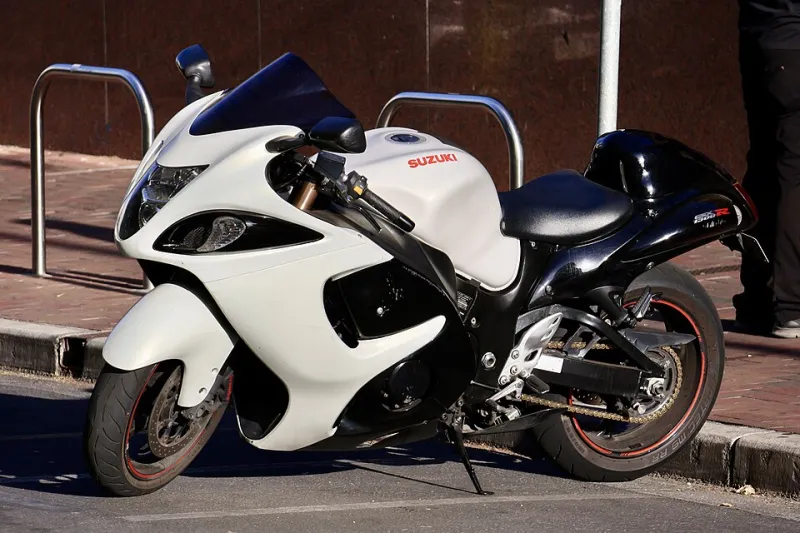
Photo: Designer Mario Kleff, CC0, via Wikimedia Commons
Some motorcycles earn their reputation on the track. Others earn it in the twisties. The Suzuki Hayabusa earned a big chunk of its legend in front of a camera lens, usually parked on wet pavement under colored lights while a rapper leaned against it.
If you came of age watching MTV in the early 2000s, you already know the image: chrome wheels, stretched swingarm, a bike that looked less like transportation and more like a prop from the future. The Busa wasn't just in the background of hip-hop culture — it became part of the furniture. And two decades later, that relationship is still paying dividends on showroom floors across the country.
The Bike That Outgrew Its Spec Sheet
When Suzuki launched the Hayabusa in 1999, the pitch was pure engineering: the fastest production motorcycle on Earth, named after a peregrine falcon that dives on prey at over 180 mph. That's a great story for the spec sheet. But what made the Busa culturally sticky was the way it looked doing 60 mph in traffic.
The silhouette was unlike anything else — organic, aggressive, almost alien next to the angular sportbikes of the era. It photographed well. It sat low and wide, with a presence that read as expensive even to people who couldn't name a single motorcycle model. In an industry where image is currency, that mattered.
By the time the stretch-and-chrome custom scene took off in the mid-2000s, the Busa was the canvas of choice. Big wheel kits, air ride, candy paint — the bike absorbed customization culture the way a G-Wagon absorbs aftermarket body kits. And where custom bikes went, cameras followed.
Screen Time Turns Into Showroom Time
Ask Hayabusa dealers what actually drives foot traffic and you'll hear a familiar story. Sure, some buyers arrive clutching magazine lap times. But plenty of others show up saying some version of the same thing: I've wanted one since I was a kid watching videos.
"You can trace it generationally," one Southeast dealer told us. "Guys in their forties remember the Busa from DVDs and bike builds. Guys in their twenties? They found it through streaming, through social clips, through artists still putting hawks in their visuals. The bike never left the culture — the delivery method just changed."
That's the quiet genius of the Busa's pop-culture run. It never depended on one artist, one video, or one era. It became shorthand — a visual cue for having made it, for speed, for not needing to explain yourself. When an artist wants to signal that energy on screen, the Busa is on the shortlist, and it has been for twenty years.
The Riders Who Followed the Music
We talked to a few owners whose Busa purchases trace straight back to a screen.
Marcus, 38, from Atlanta, bought his first Busa in 2012. "I wasn't a sportbike guy. I grew up on big cruisers. But every video I loved had that bike in it. When I finally sat on one at a dealer, it was over. It felt like the videos looked."
Deja, 27, out of Houston, came at it from the other direction. "My generation doesn't watch music television. We see clips. We see the bike in a video, then we see it on Instagram, then we see a build at a car show. By the third time, you're researching prices at midnight."
What's striking is how consistent the language is across generations. Nobody talks about top speed first. They talk about presence — how the bike makes them feel parked outside a spot, how it photographs, how it announces something before the rider says a word. That's pop culture doing the selling long before a salesperson gets involved.
Why the Busa and Not Something Else
Plenty of fast bikes exist. So why did the Hayabusa corner the cultural market?
A few reasons stack up. First, timing: the Busa hit its stride exactly when music video budgets and bike custom culture peaked together in the 2000s. Second, proportions: the Busa reads as substantial on camera in a way smaller sportbikes don't. Third, and maybe most important, longevity. The Busa never got canceled or redesigned into something unrecognizable. When Suzuki rebuilt it for 2022, it stayed unmistakably a Busa — same spirit, sharper execution. Cultural icons need continuity, and Suzuki delivered it.
There's also the custom scene's embrace. A bike that accepts a 240 rear tire and a turbo kit without complaint is a bike builders love to show off, and every show-stopping build becomes another piece of free marketing.
The Hawk's Second Act
Here's the kicker for anyone shopping right now: the cultural cachet and the current product finally line up. The third-generation Hayabusa isn't a nostalgia play — it's a genuinely modern machine with rider aids, cornering ABS, and electronics the 2005 version couldn't dream of. Buyers who fell in love with the bike through a screen are getting the real thing, and the real thing is better than the fantasy.
Dealers are leaning in, too. Campaign pricing, launch events, and demo days are increasingly pitched at exactly the buyers the culture created — people who want the icon, not just the motorcycle. If you've been circling a Busa since the first time you saw one glinting under stage lights, this is a good moment to stop circling.
The Hayabusa never needed to chase pop culture. Pop culture came to it, parked next to it, and put it in the shot. Twenty-five years in, the hawk is still the one on camera — and unlike most props, it actually flies.