Know Your Hawk: How to Tell Every Hayabusa Generation Apart at Bike Night
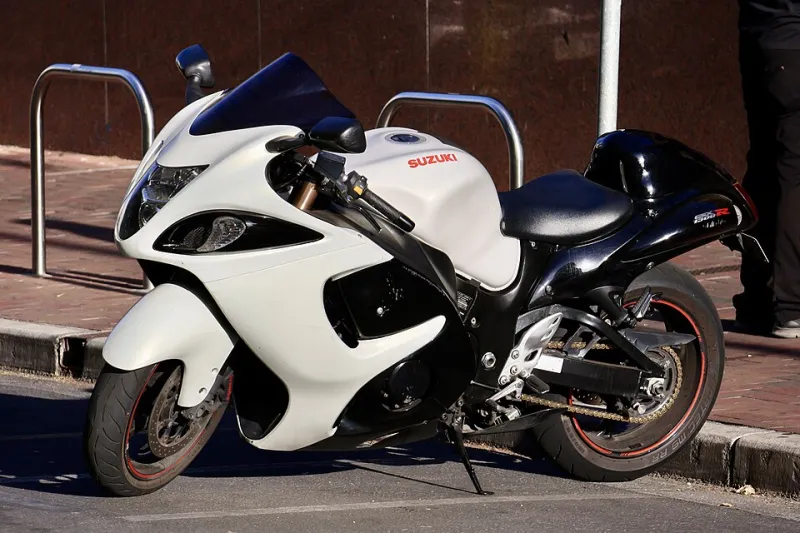
Photo: Pangalau, CC BY-SA 4.0, via Wikimedia Commons
There's a moment that happens at every bike night in America. Someone rolls in on a Hayabusa, a group gathers, and somebody squints and asks, "Is that a Gen 2?" Half the time the answer is wrong. It's not because people don't care — it's because the Busa's silhouette has stayed so stubbornly consistent for 25 years that the tells are easy to miss unless you know where to look.
Consider this your cheat sheet. Next time you're at a Tuesday night meet in the Kroger parking lot or a bigger rally like Biketoberfest, you'll be able to size up any Hayabusa in the lot like a seasoned birder checking off species.
Gen 1 (1999–2007): The Original Shape of Speed
The first-generation Busa is the one that rewrote the rulebook, and it's still unmistakable once you've been shown the secret. Look at the front end: Gen 1 bikes have dual headlights stacked in that distinctive hawk-face fairing, and the mirrors mount high on the fairing itself.
The rear is the real giveaway, though. Gen 1 Hayabusas carry that sculpted, almost humped tail section with the turn signals integrated low, and the underseat area looks chunkier than what came later. If you spot a chrome or brushed steel exhaust canister that looks like a rolled-up newspaper tucked under the tail, you're probably looking at a first-gen.
Wheels are another clue. Early bikes ran three-spoke rims; later Gen 1s got a three-spoke design that's still visually distinct from the Gen 2's six-spoke pattern. Colors help too — the late-90s palette leaned hard into deep pearl finishes and bold two-tone schemes that scream "turn of the millennium."
Bonus tip: a Gen 1 with a full exhaust, a lowered stance, and a stretched swingarm isn't rare at American meets. That's the drag-bike lineage, and the owner probably has opinions about the 1/8th mile.
Gen 2 (2008–2020): The Refinement Years
The second generation kept the silhouette but sharpened everything. The easiest tell? The exhaust. Suzuki moved to a larger, more angular muffler with a matte titanium-look finish, and the tail section got sleeker with a sharper, more tapered line.
Headlights changed subtly too — the twin lights sit in a more aggressive fairing with more angular vents. If you walk around to the dash, a Gen 2 has an analog tachometer with a small digital window rather than the full LCD setup of the Gen 3.
Wheels are your friend here: Gen 2s run a distinctive six-spoke design that's easy to spot once you've seen it. And if the bike is wearing B-king-adjacent attitude or the owner mentions "the 1340 got bigger valves," you've confirmed it.
Gen 2s are the most common Busa at American bike nights for a simple reason: that 12-year production run means they're everywhere, and plenty of owners still swear the 2008–2020 bikes are the sweet spot. Buy them a beer and they'll explain why in detail.
Gen 3 (2021–Present): The Tech-Forward Hawk
The third-generation Hayabusa is the one that brought the Busa into the electronics era, and it wears its updates proudly. The fairing is all-new with more pronounced aerodynamic winglets — those little ducts on the front aren't just for show, they're functional downforce bits.
The tail is the cleanest giveaway: a sharp, upswept design with LED lighting throughout and a much more modern exhaust that's noticeably slimmer than the Gen 2 canister. Walk up to the dash and you'll find a full-color TFT display flanked by analog-style gauges — plus riding modes, cornering ABS, and the whole rider-assist suite.
Colorways are a strong clue too. The Gen 3 launched with that stunning Glass Sparkle Black/Candy Daring Red combo, and Suzuki has kept the palette premium and distinctive. If the bike looks like it rolled out of a concept sketch, it's a Gen 3.
How to Actually Talk to a Busa Owner
Here's the good news: Hayabusa owners love talking about their bikes, and the fastest way to start a conversation is to ask which generation it is. Even if you guess wrong, you've just handed them the perfect opening to explain their bike's story.
A few conversation starters that work every time:
- "What year is it? I'm still learning the generations." (Honesty works.)
- "Is it stock, or has it been in the mod pile?" (Every Busa owner has a mod story.)
- "How does it compare to the new one?" (Works on Gen 1 and 2 owners especially.)
Don't ask "how fast does it go?" — you'll get a polite answer, but you've just revealed yourself as a tourist. Ask about the ownership experience instead: maintenance, comfort, what they'd change. That's where the real intel lives.
Why Bike Nights Beat the Showroom Floor
If you're shopping for a Hayabusa this year, bike nights are the best free research tool in America. At a dealership, the bike sits under lights with a price tag. At a meet, you see three generations parked side by side, hear them start up, and watch how owners actually interact with their machines.
You'll also learn what the market really thinks. Ask a Gen 1 owner what they'd buy today and you'll get a different answer than a Gen 3 owner — and that range of perspective is worth more than any spec sheet.
So next time the bikes gather at your local spot, do a little hawk watching. Count the tail sections, check the exhausts, and strike up a conversation. The Hayabusa community is one of the most welcoming corners of American motorcycling, and every owner there was once the person squinting across the parking lot, trying to figure out which generation they were looking at.